
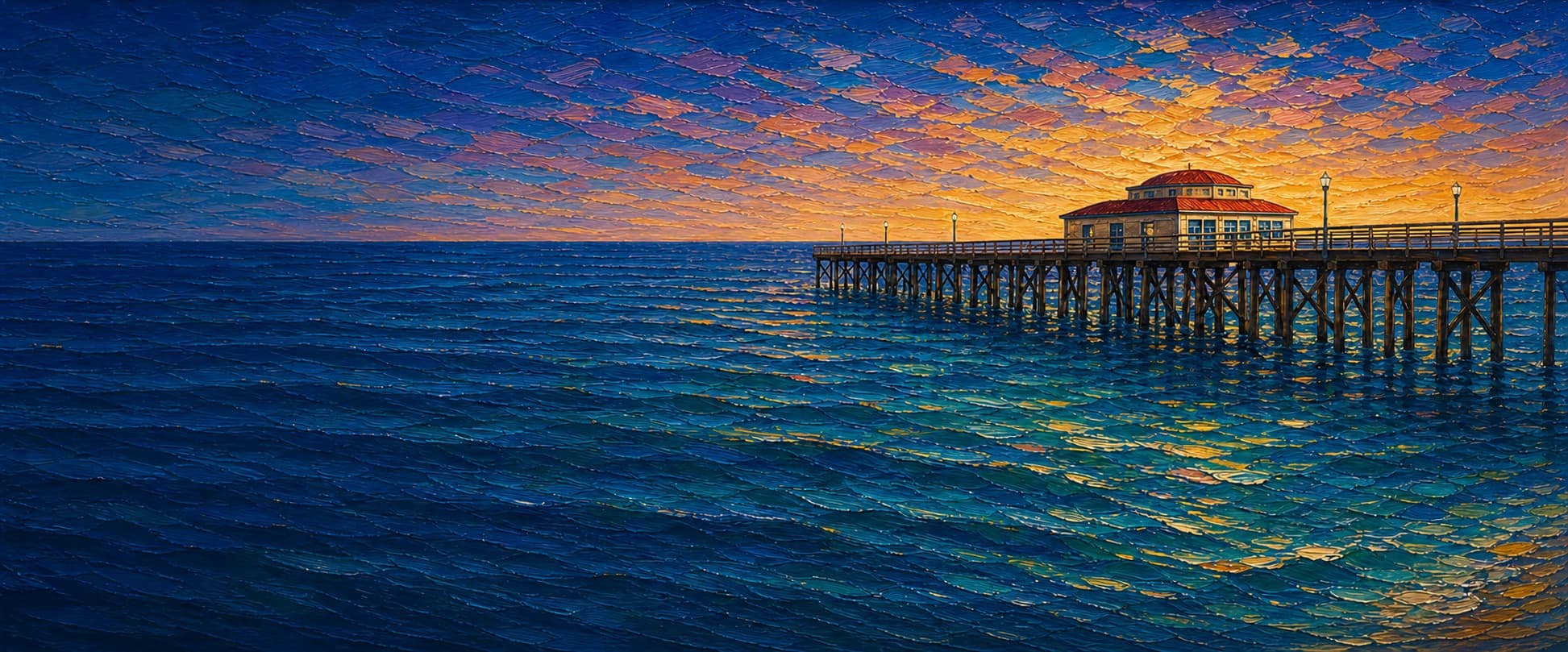
Balboa Pier
Balboa Peninsula, Newport Beach, California

Fishing conditions
Loading…
National Weather Service (api.weather.gov)
Loading…
NOAA CO-OPS predictions, station 9410580
- Sunrise—
- Sunset—
Dawn/dusk and a moving tide (the hour around a high or low) typically bring the most active bite — worth timing a trip around whichever falls closest to first/last light.
Loading…
Loading buoy telemetry…
NOAA National Data Buoy Center
A straight, narrow ocean pier on the Balboa Peninsula, extending roughly 920 feet over the sand to a small end building/concession. The City describes that building as having operated as a concession and bait-and-tackle shop before becoming the original Ruby's Diner; the City approved a seven-year lease extension in 2025 to support maintenance and a future remodel. The deck and piles read as timber in the pier inventory/local fishing coverage, but that material claim was not independently verified from a City engineering record.
Species & regulations
Fish a lawful live bait or an artificial close to the bottom in the mid-pier area; the local pier report calls the middle the best halibut water.
⚠ OEHHA's South of Seal Beach Pier to San Mateo Point advisory: women 18–49 and children 1–17 should limit California halibut to 1 total serving per week; women 50+ and men 18+ to 2 total servings per week. Eat skinless fillets only.
Use a Sabiki or small bait rig at the end, varying depth until a school is found; the local report places both species at the far end.
⚠ OEHHA's South of Seal Beach Pier to San Mateo Point advisory lists Pacific chub mackerel at 2 total servings per week for women 18–49/children 1–17 and 4 for women 50+/men 18+; verify species identification and current advice.
Fish sand crabs or other legal natural bait in the inshore wash. The local pier report lists occasional corbina from the beach-side area.
⚠ OEHHA's South of Seal Beach Pier to San Mateo Point advisory limits California corbina to 2 total servings per week for both advisory population groups; eat skinless fillets only.
Use small hooks and natural bait around, but not directly in, the mussel-covered mid-pier piles; the local report lists sargo from midway out.
⚠ OEHHA's South of Seal Beach Pier to San Mateo Point advisory: 1 total serving per week for women 18–49/children 1–17 and 1 for women 50+/men 18+; eat skinless fillets only.
Use small hooks with sand crabs, mussel, or worms in the inshore wash; the local report identifies surfperch as a regular beach-side catch.
⚠ OEHHA's South of Seal Beach Pier to San Mateo Point advisory groups surfperch at 2 total servings per week for both advisory population groups; eat skinless fillets only.
Bag/size limits sourced from CDFW's ocean sport fishing regulations — always double-check the current CDFW regs before keeping fish, as rules change.
Moon tracker
Recommended spots
- Mid-pier bottom water
 Bottom / halibut
Pier Fishing in California identifies the middle as the strongest zone for California halibut, alongside white croaker and queenfish. Present legal bait close to bottom and just outside the mussel-covered piles.
- End rail — pelagic laneOpen water / mackerel and bonito
The local guide specifically identifies the far end for Pacific and jack mackerel, and bonito in some years. A Sabiki or small bait rig can cover the water column; do not crowd the restaurant/concession area.
- Mid-pier piling edge

 Structure edge / mixed species
The report lists sargo, topsmelt, jacksmelt, sardines, scorpionfish, shovelnose guitarfish, and occasional bass or barracuda in middle water. The documented piling mussels add structure but also a real snag risk.
- End bottom railDeepest available water / rays
The guide describes the end as the best area for larger sharks and rays and notes the pier's relative proximity to Newport Submarine Canyon. This is conditional opportunity, not a depth survey or a guarantee.
- Inshore surf zoneSurf / perch and croaker water
The local pier report places surfperch, small rays, and occasional croaker or corbina in the beach-side water. Work natural bait in the wash, maintaining safe clearance from swimmers and surfers.
Landmarks
- Balboa Pier entrance — Ocean Front and Palm Street
 access
Generalized from the mapped pier base. City beach information lists Balboa Pier as open 5 a.m.–midnight; confirm posted closures on arrival.
- Balboa Pier Parking Lot
 amenity
City lists paid 24-hour parking at Palm Street and Balboa Boulevard (614 spaces); rates and availability vary.
- Base restroom facilitiesamenity
The City says public restroom facilities are available at the base of both Newport Beach piers; exact fixture location was not pin-mapped for this draft.
- Peninsula Parkamenity
Local pier coverage places the lawn, palms, ball field, and bandstand at the foot of the pier.
- Ruby's Diner end concession
 structure
City lease records identify the premises at 1 Balboa Pier. It occupies the end area, so leave clearance around restaurant operations and any posted fishing restrictions.
- Mussel-covered piling line
 hazard
Pier Fishing in California describes the pilings as heavily covered with mussels. Fish adjacent water rather than casting directly into the pile line to reduce snags.
Vegetation / growth assessment
The available local fishing guide says the pilings are heavily covered with mussels but that there is rarely much kelp or seaweed around the pier. Public aerial/kelp sources are useful for surface canopy at broader scales, not for resolving submerged fouling on individual piles; this assessment therefore records light baseline water vegetation and a cautious moderate piling-associated band rather than claiming a mapped kelp bed.
Piers grow algae, mussels, and barnacles on their pilings and along the deck edges over time — that build-up is what this section tracks. The more growth in a stretch, the easier it is for your hook, sinker, or line to catch on it and get stuck, which is one of the most common ways beginners lose tackle. Heavier growth isn't a reason to avoid a spot — it often holds bait and structure fish like — just expect to snag more and re-tie more often there.
The most growth on Balboa Pier is on the right flank, mid-structure — expect occasional snags there; nothing else on the structure reads heavier.
- Right flank · noneunconfirmed, not yet assessed
No flank-specific vegetation observation was independently verified here; gridded as checked, none confirmed.
- Right flank · noneunconfirmed, not yet assessed
No flank-specific vegetation observation was independently verified here; gridded as checked, none confirmed.
- Left flank · lightsome growth, light snag risk
No persistent surface kelp canopy was verified at pier scale; this does not establish clean submerged piles.
- Right flank · moderatemoderate growth, expect occasional snags
Piling-associated mussel/biofouling flag based on the local pier report, not an aerially resolved vegetation patch; either flank may have similar fouling.
- Outer end · lightsome growth, light snag risk
No surface canopy was established beyond the end. Width is a cautious approximate end-building/deck span, not a surveyed dimension.
Reference sources
- City of Newport Beach — 2025 Balboa Pier concession staff report
- OpenStreetMap — Balboa Pier way 188709103
- OpenStreetMap Nominatim — Balboa Pier search
- Pier Fishing in California — Balboa Pier
- City of Newport Beach — Beach information
- City of Newport Beach — Balboa Pier parking lot and rates
- NOAA Tides & Currents — Newport Beach, Newport Bay Entrance station 9410580
- CDFW — Current Southern California ocean recreational regulations
- CDFW — General ocean finfish regulations
- CDFW Marine — public-pier fishing license exemption
- OEHHA — South of Seal Beach Pier to San Mateo Point fish-consumption guide
- Kelpwatch — statewide kelp canopy map
- CDFW — Aerial Kelp Surveys